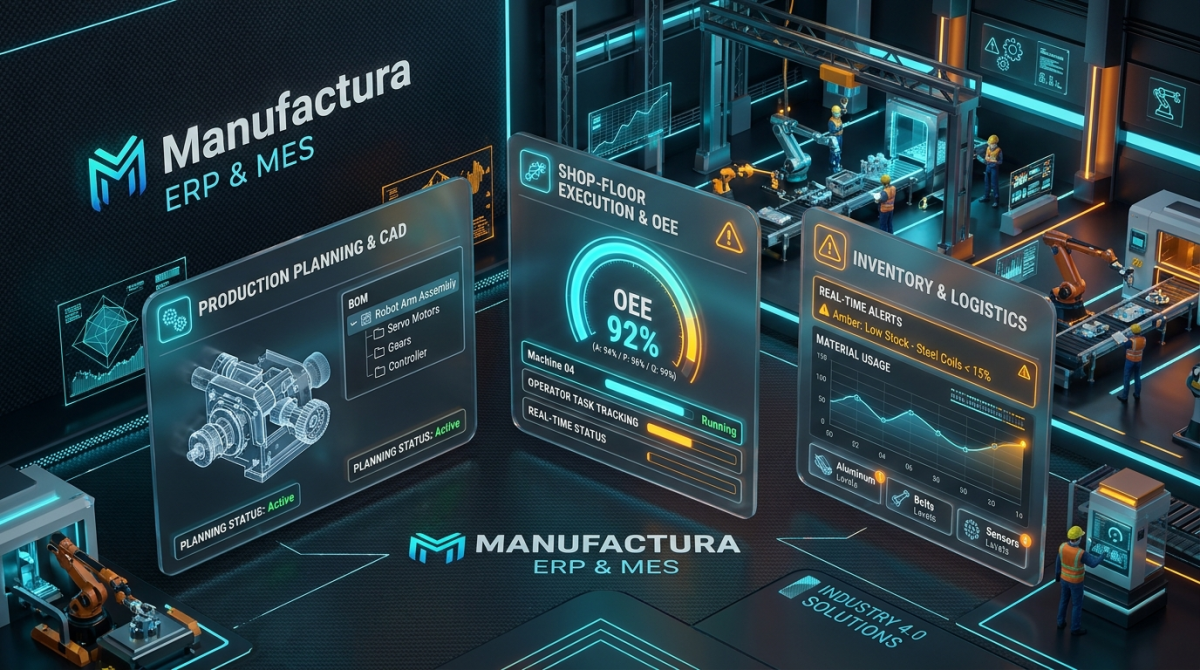
Navigating Shop Floor Chaos and Raw Material Shortages
Industrial manufacturing facilities operate under strict delivery timelines, fluctuating raw material prices, and demanding quality standards. When factory managers rely on disjointed spreadsheets for production scheduling, assembly lines experience frequent downtime due to missing sub-components, unexpected machine bottlenecks, and unrecorded scrap wastage.
Multi-Level Bill of Materials (BOM) with Scrap Allowances
Manufactura Industrial ERP supports complex multi-tiered hierarchical Bill of Materials trees. Production engineers define exact raw material components, sub-assemblies, labor hours, and machine tooling requirements, including scrap factor multipliers to ensure realistic material requirement calculations.
Dynamic Work Order Dispatch & Machine Workstation Routing
Transform approved sales orders into actionable production work orders with one click. The shop floor scheduling module automatically routes orders through required sequential workstations (such as Cutting, CNC Machining, Welding, Powder Coating, and Final Assembly), balancing job queues and preventing machine idle time.
Automated MRP Planning & Predictive Reorder Triggers
The Material Requirements Planning (MRP) engine continuously compares current warehouse inventory against active shop floor work orders. As raw material balances approach safety thresholds, the system automatically triggers purchase requisitions to vetted suppliers, preventing assembly line halts.
In-Process Quality Control (QC) & Inspection Checkpoints
Maintain ISO and regulatory compliance with integrated quality checkpoints. Quality control inspectors record physical measurements, upload tolerance test logs, and issue Certificates of Analysis (CoA). Defective parts are quarantined instantly with documented root-cause failure codes.
The Impact: Reduced Scrap, On-Time Deliveries & Margin Protection
Industrial manufacturing plants using Manufactura achieve significant reductions in component shortages, optimize machine throughput, and protect unit profit margins through accurate standard-versus-actual costing comparisons.